


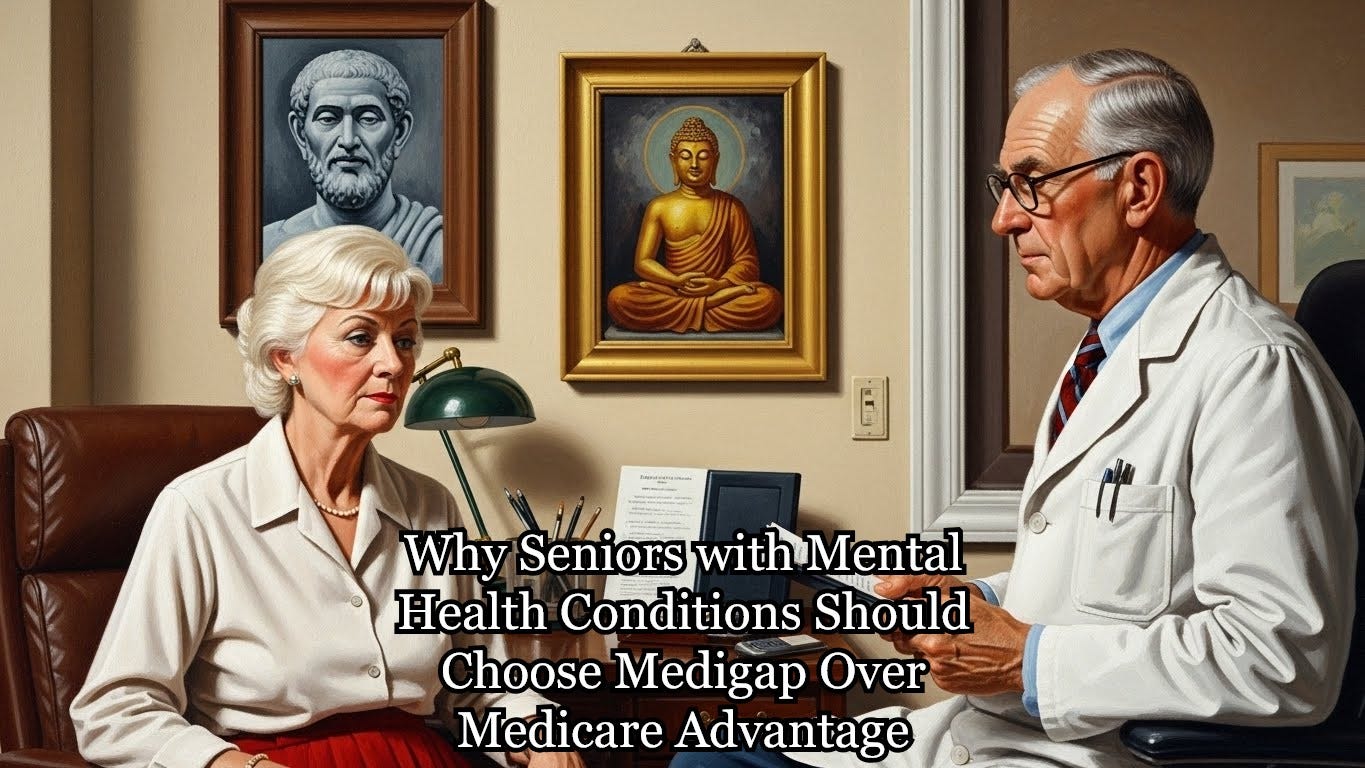
If you’re 65 or older and managing a mental health condition, the type of Medicare coverage you choose could significantly impact your ability to access the care you need. Recent research published in The American Journal of Managed Care reveals a troubling pattern: Medicare beneficiaries with mental health conditions who switch from Medicare Advantage (MA) back to Traditional Medicare with Medigap coverage experience dramatically improved access to care.
The study, which analyzed over 1,100 beneficiaries who made this switch, found that people needed more mental health visits after leaving Medicare Advantage—suggesting they weren’t getting adequate care while enrolled in MA plans. Even more revealing: 10% of beneficiaries who never saw a psychiatrist while in Medicare Advantage were able to see one after switching to Traditional Medicare. In comparison, only 2% of those who stayed in Medicare Advantage gained access to psychiatric care.
This isn’t just about numbers in a research paper. This is about your mental health, your quality of life, and your ability to get the specialized care you need when you need it.
Five Critical Reasons Why Medigap Outperforms Medicare Advantage for Mental Health Care
1. Escape the Provider Network Trap
Medicare Advantage plans operate using restrictive provider networks, and mental health providers are disproportionately excluded. The research is stark: more than two-thirds of Medicare Advantage plans include less than 25% of local Medicare-accepting psychiatrists in their networks.
Think about that for a moment. If you live in an area with 100 psychiatrists who accept Medicare, your MA plan likely gives you access to fewer than 25 of them. And here’s the kicker: psychiatry ranks in the top 10 most restricted specialties across all Medicare Advantage plans. Research published in Health Affairs found that nearly two-thirds of psychiatrist networks in Medicare Advantage were considered “narrow,” compared to only about 40% in Medicaid managed care and Affordable Care Act marketplace plans—meaning Medicare Advantage has the most restrictive mental health networks of any major insurance market.
The situation is even worse than the statistics suggest. A 2024 report from the Department of Health and Human Services Office of Inspector General found that 72% of behavioral health providers listed in Medicare Advantage directories are actually unavailable—these “ghost networks” include providers who have retired, moved, or don’t actually accept the plan. So not only are the networks narrow, but the directories themselves are unreliable.
With Traditional Medicare and a Medigap supplement, you have access to any Medicare-participating provider in the country. No network restrictions. No surprise denials because your psychiatrist isn’t “in-network.” You choose your mental health provider based on who’s best for you, not based on who your insurance company has contracted with.
2. Eliminate Prior Authorization Delays
Medicare Advantage insurers frequently require prior authorization before you can see specialists or receive certain treatments. A 2024 Government Accountability Office (GAO) report found that 8 out of 9 major Medicare Advantage organizations require prior authorization for behavioral health services, particularly for inpatient mental health care and specialized treatments. According to the Kaiser Family Foundation, 84% of Medicare Advantage enrollees are in plans that apply prior authorization to mental health services. In contrast, Traditional Medicare currently requires no prior authorization for any behavioral health services.
For someone experiencing depression, anxiety, bipolar disorder, or other mental health conditions, delays in treatment aren’t just inconvenient—they can be dangerous. Behavioral health provider associations told the GAO that prior authorization can delay discharge from inpatient mental health units to appropriate outpatient programs, leaving patients in more restrictive and expensive settings than medically necessary.
The American Medical Association’s 2023 survey of physicians found that 88% characterized the administrative burden from prior authorization as “high” or “extremely high,” and that prior authorization often delays care and results in negative clinical outcomes. For psychiatric medications specifically, prior authorization and step therapy requirements are associated with higher hospitalization rates, higher overall medical costs, and even higher incarceration rates due to uncontrolled mental illness.
Even more troubling: the HHS Office of Inspector General found that 13% of Medicare Advantage prior authorization denials actually met Medicare coverage rules and should have been approved. These denials force patients and providers into time-consuming appeals processes—and 82% of appealed denials are ultimately overturned, meaning patients experienced unnecessary delays for care that was appropriate all along.
Traditional Medicare with Medigap doesn’t require prior authorization for most services. When your doctor says you need care, you get care. No waiting for insurance company approval. No fighting with bureaucrats who’ve never met you about whether you really need that therapy session or medication.
3. Access Psychiatrists When You Need Them
Here’s a sobering finding from the research: among beneficiaries who didn’t see a psychiatrist while enrolled in Medicare Advantage, 10% were able to access psychiatric care after switching to Traditional Medicare. That’s five times higher than the 2% of MA beneficiaries who gained access to psychiatrists while staying in their MA plans.
This tells us something crucial: Medicare Advantage plans are failing to connect seniors with specialized mental health care. Whether it’s due to narrow networks, prior authorization hurdles, or other managed care tactics, the result is the same—people who need psychiatrists can’t get to them.
Psychiatric care isn’t a luxury. For conditions like major depression, bipolar disorder, schizophrenia, and severe anxiety disorders, access to a psychiatrist can be the difference between stability and crisis, between managing symptoms and ending up in the emergency room.
4. Reduce Inappropriate Emergency Department Use
The study found that after switching from Medicare Advantage to Traditional Medicare, beneficiaries with mental health conditions had 26% fewer emergency department visits for mental health care. This is a clear sign that people in MA plans were using emergency departments because they couldn’t access appropriate outpatient mental health services.
Emergency departments are expensive, traumatic, and not designed to provide ongoing mental health treatment. They’re for crises, not for managing chronic conditions. The fact that MA beneficiaries were relying on emergency care suggests a fundamental failure of their insurance plans to provide adequate access to psychiatrists, therapists, and other mental health professionals.
With Medigap, you’re more likely to establish relationships with mental health providers who can see you regularly, adjust medications, provide therapy, and help you avoid crises that land you in the ER.
5. Maintain Continuity of Care as Your Needs Change
One of the most important findings in the research is the overall pattern it reveals: people with mental health conditions are voting with their feet by leaving Medicare Advantage for Traditional Medicare. And when they make that switch, their healthcare utilization patterns improve.
This isn’t unique to mental health. Multiple studies have documented that high-need beneficiaries disenroll from Medicare Advantage at higher rates than healthier enrollees. Research published in Health Affairs found that among high-need enrollees, 4.6% switched from Medicare Advantage to Traditional Medicare, compared to only 3.3% of non-high-need enrollees. People who become disabled, require nursing home care, or need home health services are significantly more likely to leave Medicare Advantage.
A 2024 University of Michigan study that analyzed patient satisfaction surveys found that inability to access needed care—not cost—was the primary driver of people leaving Medicare Advantage for Traditional Medicare. Another study found that Medicare spending was 27% higher for people who disenrolled from Medicare Advantage compared to similar people continuously in Traditional Medicare, suggesting they had unmet healthcare needs while in MA plans.
This matters because mental health conditions often worsen with age or become more complex as other health issues develop. You need an insurance structure that can adapt to your changing needs, not one that becomes more restrictive precisely when you need more care.
With Medigap, your coverage remains consistent regardless of how your health changes. No annual network changes that might eliminate your psychiatrist. No new prior authorization requirements that could interrupt your treatment. No surprises.
The Bottom Line: Your Mental Health Is Too Important to Compromise
Medicare Advantage plans market themselves with appealing benefits—dental coverage, gym memberships, low or zero premiums. But for seniors with mental health conditions, these perks come at a steep price: restricted access to the specialists and services you actually need.
The research is clear. When people with mental health conditions switch from Medicare Advantage to Traditional Medicare with Medigap, they see more mental health providers, access psychiatrists more frequently, and rely less on emergency departments for mental health care.
Your mental health matters. Your ability to see the providers you need, when you need them, matters. Don’t let slick marketing and extra benefits distract you from what’s essential: comprehensive, unrestricted access to mental health care.
If you’re currently in Medicare Advantage and struggling to access mental health services, you may be able to switch during the Annual Enrollment Period (October 15 - December 7) or, in some cases, during a Special Enrollment Period.
However, there’s an important caveat: switching from MA to Medigap later in life can be challenging in some states due to medical underwriting requirements. Johns Hopkins researchers have identified what they call the “Medicare Advantage trap”—when beneficiaries first become eligible for Medicare, they can purchase Medigap without health questions during their one-time, six-month open enrollment period. But if they choose Medicare Advantage instead and later want to switch to Traditional Medicare with Medigap, they may face medical underwriting, high premiums, or outright denials based on their health conditions.
This means the coverage decision you make when you first become eligible for Medicare at age 65 can have lasting consequences. It’s another reason to choose wisely from the start—Medigap provides the freedom and flexibility you’ll want if your health needs change.
The choice between Medicare Advantage and Medigap isn’t just about comparing benefits on paper. It’s about understanding how these different insurance structures actually function when you need care. For mental health conditions, the evidence overwhelmingly supports Traditional Medicare with Medigap supplemental coverage.
Are you in Medicare Advantage and struggling to access mental health care? Or approaching 65 and unsure which Medicare path to choose? The coverage decision you make now can have lasting consequences for your access to specialists and treatment. Treveri Capital specializes in Medicare planning for individuals with complex health needs. Contact us to discuss your coverage options before the next enrollment period.
Additional Sources:
“Mental Health Care Use After Leaving Medicare Advantage for Traditional Medicare” by Angela Liu, PhD, Blake Ayers, MPH, and Mark K. Meiselbach, PhD, published in The American Journal of Managed Care, December 2025.
Zhu JM, Meiselbach MK, Drake C, Polsky D. “Psychiatrist Networks in Medicare Advantage Plans Are Substantially Narrower Than in Medicaid and ACA Markets.” Health Affairs 42, no. 7 (2023): 909-918.
U.S. Department of Health and Human Services, Office of Inspector General. “Many Medicare Advantage and Medicaid Managed Care Plans Have Limited Behavioral Health Provider Networks and Inactive Providers.” October 2024.
U.S. Government Accountability Office. “Medicare Advantage: CMS Oversight of Prior Authorization Criteria Should Target Behavioral Health Services.” GAO-25-107342, November 2024.
U.S. Department of Health and Human Services, Office of Inspector General. “Some Medicare Advantage Organization Denials of Prior Authorization Requests Raise Concerns About Beneficiary Access to Medically Necessary Care.” OEI-09-18-00260, April 2022.
Kaiser Family Foundation. “Medicare Advantage Insurers Made Nearly 50 Million Prior Authorization Determinations in 2023.” August 2024.
American Medical Association. “2023 AMA Prior Authorization Physician Survey.” 2024.
Rahman M, Keohane L, Trivedi AN, Mor V. “High-Cost Patients Had Substantial Rates of Leaving Medicare Advantage and Joining Traditional Medicare.” Health Affairs 34, no. 10 (2015): 1675-1681.
Ankuda CK, Ornstein KA, Covinsky KE, et al. “Switching Between Medicare Advantage and Traditional Medicare Before and After the Onset of Functional Disability.” Health Affairs 39, no. 5 (2020): 809-818.
Hoffman GJ, Levine DA, Kim HM, et al. “Medicare Advantage Plan Disenrollment: Beneficiaries Cite Access, Cost, and Quality Among Reasons for Leaving.” Health Affairs 43, no. 6 (2024).
Kaiser Family Foundation. “Medicare Spending Was 27% More for People Who Disenrolled from Medicare Advantage Than for Similar People in Traditional Medicare.” August 2024.
Liu A, Pittman D, Anderson G, Xu J. “Medigap-Guaranteed Issue Associated With Medicare Advantage Disenrollment for Beneficiaries Administered a Part B Drug.” Health Affairs Scholar 2, no. 11 (2024): qxae136.
Copyright © 2025 All rights reserved. This email is copyright protected. No part may be reproduced, altered, or copied in any form without written consent. Information contained herein is for informational purposes only and should not be construed as an offer, solicitation, or recommendation to buy or sell securities, or personalized investment, tax or legal advice. The information has been obtained from sources believed to be reliable; however no guarantee is made or implied with respect to its accuracy, timeliness, or completeness. Authors may own the stocks they discuss. The information and content are subject to change without notice. Treveri Capital LLC is a California registered investment advisor. CRPC®, Chartered Retirement Planning CounselorSM are trademarks or registered service marks of the College for Financial Planning in the United States and/or other countries.