


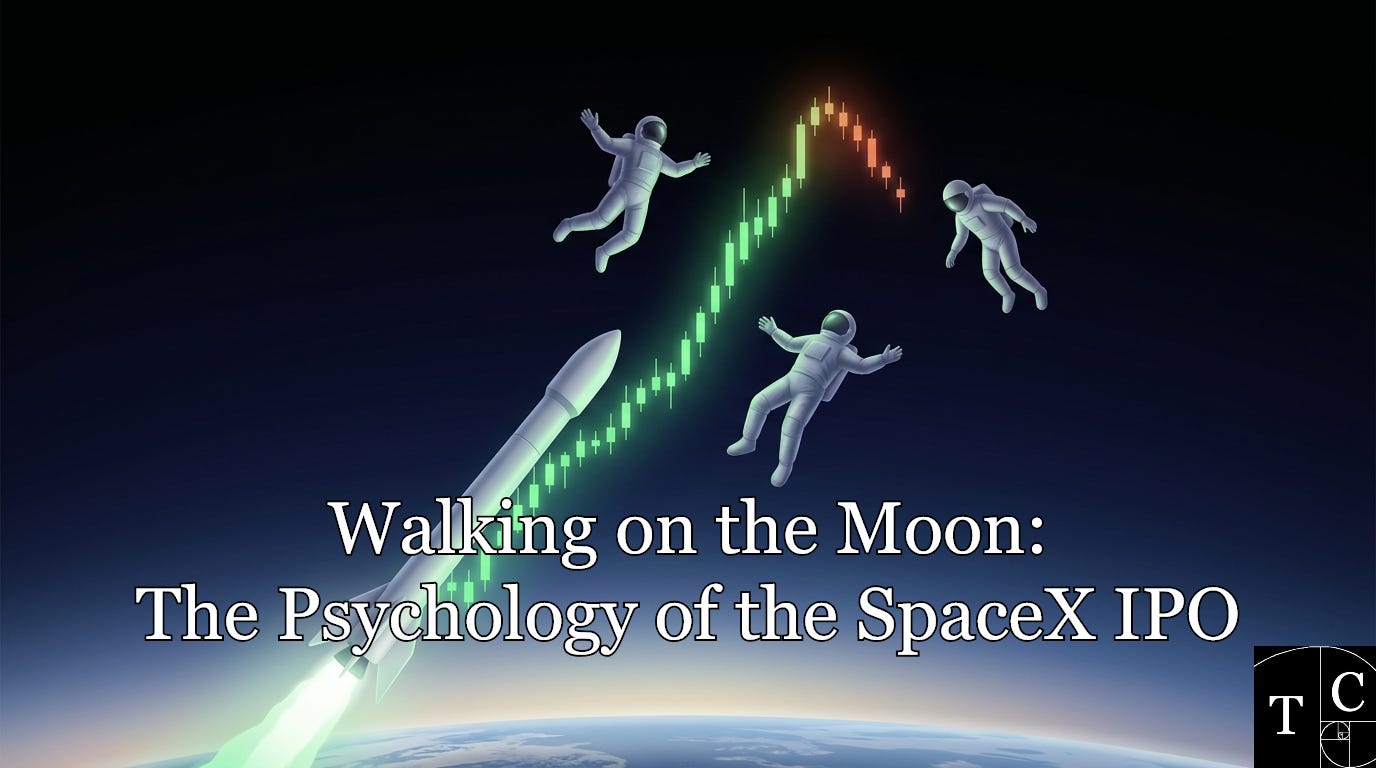
In 1979, The Police released “Walking on the Moon.” Sting wrote it after a drunken night in a Munich hotel room, and what came out was a song about being in love. To be in love, he said, is to be relieved of gravity. On the day SpaceX lists, a lot of investors are going to feel the same way with mixed emotions. There are three kinds of investor in love with SpaceX: the pre-IPO holders, the investors allocated at the offer price, and the buyers who pile in once it trades. Three seats with the same loss of gravity. Underneath it all, the same emotional decisions.
Markets run on a short list of fears. Almost every investing error comes from four of them: being wrong, losing money, missing out, and leaving money on the table. The market itself is neutral. It does not know you exist. The fear is something you bring to it. Three seats, four fears, and almost every decision comes down to the strongest internal voice.
The Pre-IPO Investors
The pre-IPO investors have owned it for years, in long before today’s valuation. You would think they have nothing to fear. They have two of the four: leaving money on the table and losing money. They cannot sell yet, because their shares are locked up for months and Musk’s for more than a year. The lockup removes the choice but not the fear. Sell when it lifts and the price could keep climbing, the gain left on the table growing with every print. Hold and the move could fade, handing back a paper fortune never cashed. Two fears at war, with the calendar deciding when they have to pick one.
The IPO Investors
The IPO investors got the seat everyone wants, allocated at the offer price before a single public trade prints. If the stock opens higher, they are up on day one, with no lockup to hold them. That freedom is its own trap. The same two fears hit them, only faster. Sell into the opening pop and watch it run for another week: leaving money on the table. Hold for that run and watch it fade by the afternoon: losing money. Their edge is not the entry price, which can vanish the moment the stock opens and sells off. It is the calendar. Unlike the pre-IPO holders, they are not locked, so they can act on either fear the second it trades. The whole decision just compresses into the first hours.
The Post-Trading Investors
The post-trading investors are most of us, the buyers who never got an allocation. They also hold the one advantage no one else has: they get to watch. Nothing forces them in. They can buy the first hour, wait a week, wait a month to see how it actually trades, or pass entirely, deciding with real price action that the locked holders and the allocated investors never had in front of them.
The fear of missing out is what makes them throw that edge away. It does not push you to buy a good business. It pushes you to buy a moving one. You see the open, you see green, and the part of your brain doing the buying is not asking what the company is worth. It is asking how it will feel to watch it run without you. So you buy the open and surrender the patience that was your whole advantage. Then the other fear answers: losing money. What if this is the high, the move fades, and you are underwater by summer? Caught between missing out and losing money, the real risk is not missing SpaceX. It is letting whichever fear is louder spend an edge the others would have killed for.
One Event, Three Reactions
Strip away the seats and it is one stock and three versions of the same fear. The pre-IPO holder afraid of selling too soon or riding it back down. The allocated investor running that choice inside the first hour. The retail buyer torn between missing the move and buying the top. Different entry points, different clocks, but the same fears doing the deciding. Three of the four show up by name. The fourth, being wrong, hides under the others: it is what makes the holder cling past the unlock and the buyer refuse to sell a loser, all to avoid admitting the call was bad. The company underneath does not care. It will keep being the same company whatever the price does.
That is why the useful question is never whether SpaceX will work. It is whether you are following a plan you set, and a risk you accepted, before the price could touch you. If you are on the outside, patience is your edge, so decide what SpaceX is worth to you and how much you are willing to lose, then let the open pass if it prints higher. If you are allocated, set your sell rule before the bell. If you are holding from the private rounds, decide what makes you sell before the lockup lifts. One stock, three seats, and the only variable is which fear each investor lets drive.
Being in love is to be relieved of gravity. The trouble is that gravity always comes back, and the rocket never knew you were watching.
Sources:
SpaceX deal terms, from its amended registration statement filed with the SEC (June 3, 2026): 555.6 million Class A shares at $135, an approximately $75 billion raise, valuing the company near $1.77 trillion. Reported as the largest IPO in history, more than triple Alibaba’s prior US record and well above Saudi Aramco’s roughly $29 billion (2019). Pricing is expected after the close on June 11, with first trading June 12 on Nasdaq under SPCX. Figures are as filed and reported; final pricing sets June 11. (SEC EDGAR; Reuters, Fortune, CNBC, June 3, 2026.)
Lockup terms, from SpaceX’s Form S-1: a staggered insider lockup with a full unlock at 180 days after the offering, and a separate lock on Elon Musk’s shares running 366 days with no early-release provision. (SEC EDGAR.)
Sting, “being in love is to be relieved of gravity,” from his 2003 autobiography; the Munich origin from a 1981 interview.