


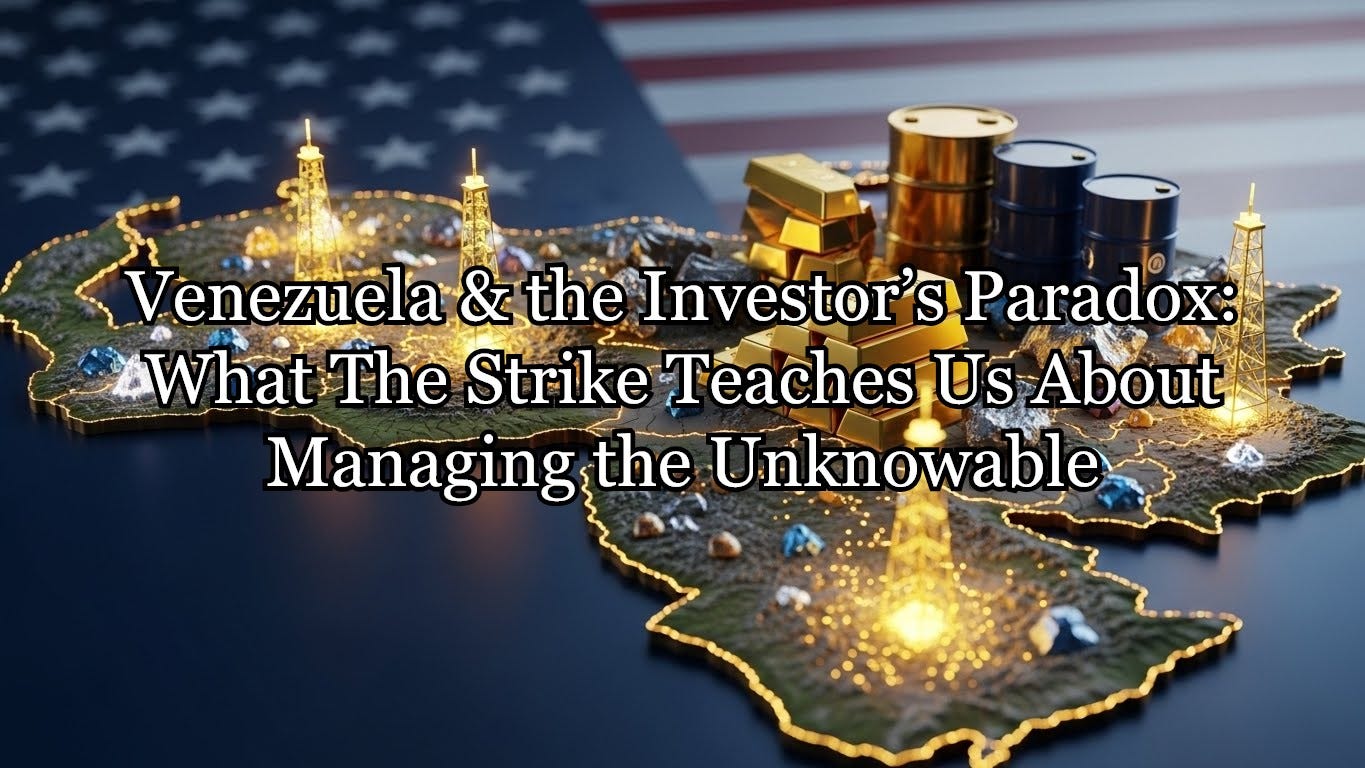
On Saturday morning, U.S. special forces captured Venezuelan President Nicolás Maduro in a military operation that stunned the world. President Trump announced that the U.S. will temporarily “run” Venezuela and work to tap the country’s massive oil reserves [1].
The immediate reaction from most investors? Paralysis.
“What does this mean for oil prices?” “Will this work or fail?” “Should I buy energy stocks or wait?” “What if it turns into another Iraq?”
Here’s the uncomfortable truth: Nobody knows. Not the experts, not the analysts, not the administration itself.
And that’s exactly why this moment is so instructive.
The Psychology of Market Uncertainty
The markets are fundamentally uncertain. Not “risky” in the sense that we can calculate probabilities—but genuinely uncertain in ways that defy prediction [2].
Venezuela is a perfect case study.
Venezuela sits on approximately 303 billion barrels of proven oil reserves—about 20% of the world’s total [3]. That’s real. That’s quantifiable.
What’s not quantifiable? Whether the U.S. can actually stabilize the country, given that Trump provided no timeline, no governance structure, and no clear succession plan [4]. The U.S. has had no diplomatic presence in Venezuela since 2019 [4]. Experts who ran war games on post-Maduro scenarios concluded you’d get “absolute chaos” without a managed transition [5].
So we have massive resources and massive uncertainty in equal measure.
Most investors respond to this by trying to resolve the uncertainty before acting. They wait for clarity. They analyze endlessly. They seek expert consensus.
This is the fatal mistake.
What We Can’t Control vs. What We Can
Here’s the framework that separates successful investors from everyone else:
You cannot predict market outcomes. You CAN predict and control your behavior [2].
Think about that distinction carefully.
Nobody knows if Venezuela becomes a U.S. energy bonanza or a multi-year quagmire. We can’t predict whether oil production reaches 4 million barrels per day in a decade or whether the whole thing collapses into factional violence.
But investors can absolutely predict—and control—how they respond to that uncertainty.
Successful long-term investors don’t panic-sell strategic holdings when geopolitical situations hit turbulence.
They don’t over-concentrate portfolios based on optimistic headlines about any single development.
They maintain strategic allocation discipline regardless of how compelling the narrative becomes.
They review portfolios based on pre-established investment criteria, not emotional reactions to news flow.
That’s the only edge that actually matters.
The Behavioral Reality of Major Events
When dramatic geopolitical events hit, investors make predictable psychological errors:
Error #1: Demanding Certainty Before Acting
The Venezuela situation will never become “clear.” It will evolve, surprise, contradict, and confound. Waiting for certainty means permanent paralysis.
The question isn’t “Do I know what will happen?” The question is “Do I have a disciplined process for acting despite not knowing?”
Error #2: Treating Uncertainty as Unique to This Event
Here’s what’s wild: investors are comfortable owning stocks where they can’t predict next quarter’s earnings, can’t predict competitive dynamics, can’t predict regulatory changes, can’t predict management decisions.
But Venezuela feels “more uncertain” because it’s dramatic and visible. It’s not more uncertain—it’s just more obvious.
Error #3: Confusing Analysis with Action
Brilliant investors often spend weeks analyzing Venezuela’s oil infrastructure, political factions, refining capacity, and geopolitical implications—and then do nothing because “it’s too uncertain.”
The analysis isn’t wrong. But analysis is just preparation for behavioral discipline. If you can’t translate analysis into disciplined action under uncertainty, the analysis is worthless [2].
The Hard Asset Thesis Through a Behavioral Lens
Let me reframe the Venezuela situation not as a prediction, but as a behavioral challenge.
The case for hard assets has been building for years based on a simple observation: the world is fragmenting, resources matter strategically, and tangible assets perform well when institutions lose credibility.
Venezuela doesn’t change that thesis. It confirms it in the most dramatic way possible.
The world’s largest oil reserves just came under U.S. control, though Venezuela currently produces only about 1 million barrels per day—less than a third of what it produced before the socialist regime took over [6].
Trump openly stated that Venezuela’s oil reserves would cover any costs the U.S. incurs [7]. That tells you the framework: resource competition is real, and nations with power will act to control strategic commodities.
Will the execution work? Nobody knows.
Does it matter for the thesis? Not really.
Because whether Venezuela succeeds brilliantly or fails spectacularly, the underlying reality remains: hard assets are becoming strategic, not just financial, holdings.
Managing Your Behavior, Not the Market
Here’s how to think about this from a behavioral discipline perspective:
Strategic Allocation Beats Reactive Decisions
Investors shouldn’t decide whether to adjust hard asset exposure based on Venezuela headlines. Portfolio adjustments should be based on strategic allocation targets, rebalancing thresholds, and risk parameters established before the headlines hit.
This removes emotion from the equation entirely.
Diversification Controls Emotional Extremes
Proper diversification means investors can participate in potential opportunities without facing catastrophic outcomes if they’re wrong. Diversified portfolios allow strategic exposure without the paralysis that comes from concentrating too heavily in any single outcome.
The allocation decision should reflect long-term strategy, not short-term directional bets.
Process Over Outcome
Investors can’t control whether Venezuela becomes a transformational opportunity or a multi-year disaster. What they can control is whether their investment decisions follow a disciplined process.
Following a sound investment process and being wrong is acceptable—it’s part of long-term investing. Abandoning the process due to emotional reactions to uncertainty is the real failure, even if it accidentally produces a favorable short-term outcome.
Discipline compounds. Emotion doesn’t.
The Paradox of Conviction Under Uncertainty
Here’s what messes with people’s heads: you need conviction to commit capital, but certainty is impossible.
How do you reconcile that?
The answer is that conviction doesn’t come from knowing outcomes. It comes from trusting your investment framework.
Confidence in maintaining appropriate portfolio allocations regardless of how Venezuela plays out is achievable. Confidence in predicting exactly how Venezuela plays out is delusion.
The first kind of conviction builds wealth. The second destroys it.
What Venezuela Actually Teaches Us
The Venezuela operation isn’t primarily an oil story or a geopolitical story. It’s a mirror that reveals how investors handle radical uncertainty.
Are you waiting for clarity that will never come?
Are you making emotional decisions based on dramatic headlines?
Are you confusing your ability to analyze with your ability to maintain discipline?
Right now, we’re watching the world’s largest oil reserves come under new control in an operation with no clear roadmap. Rebuilding Venezuela’s oil sector could take over $100 billion and a decade [8]. Or it could collapse into chaos next month.
Nobody knows which.
Here’s the reality: maintaining discipline during moments like this is hard. It goes against every instinct we have as human beings. We want answers. We want certainty. We want to do something—anything—that feels like control.
That’s why most investors struggle. Not because they lack intelligence or access to information, but because behavioral discipline under uncertainty is one of the most difficult things in investing.
The investors who succeed long-term aren’t superhuman. They’ve just built a framework that helps them stay disciplined when everything around them is chaos.
Is your portfolio positioned to handle what comes next? Not just Venezuela—but all the geopolitical shocks, market disruptions, and structural shifts that we can’t predict but know are coming?
More importantly: Do you have a disciplined investment process that keeps you on track when uncertainty is highest?
If you’re not certain about either answer, that’s exactly why you should reach out.
Contact us today to review your portfolio. We’ll assess whether your current allocations align with the kind of structural trends Venezuela represents, whether your diversification provides resilience against unknowable outcomes, and whether you have the investment framework to maintain discipline when markets test your conviction. Because the only prediction that matters is how you’ll respond to what you can’t predict. Let’s make sure you’re ready.
SOURCES
[1] Marquez, Alexandra, Tom Winter, Chloe Atkins, and Daniella Silva. “Trump says U.S. will govern Venezuela until there’s a ‘proper transition’: ‘We are going to run the country.’” NBC News, January 4, 2026. https://www.nbcnews.com/politics/white-house/trump-venezuela-nicolas-maduro-strikes-run-country-transition-military-rcna252044
[2] Douglas, Mark. Trading in the Zone: Master the Market with Confidence, Discipline, and a Winning Attitude. New York Institute of Finance, 2000.
[3] “Trump says US is taking control of Venezuela’s oil reserves. Here’s what it means.” CNN Business, January 3, 2026. https://www.cnn.com/2026/01/03/business/oil-gas-venezuela-maduro
[4] “US to ‘run’ Venezuela after Maduro captured, says Trump: Early analysis from Chatham House experts.” Chatham House, January 3, 2026. https://www.chathamhouse.org/2026/01/us-attacks-venezuela-and-maduro-captured-early-analysis-chatham-house-experts
[5] “Why the U.S. intervention in Venezuela isn’t the same as Panama.” NPR, January 4, 2026. https://www.npr.org/2026/01/04/nx-s1-5665800/u-s-interventions-venezuela-panama
[6] “Trump says US is taking control of Venezuela’s oil reserves. Here’s what it means.” CNN Business, January 3, 2026. https://www.cnn.com/2026/01/03/business/oil-gas-venezuela-maduro
[7] “Venezuela’s oil, not alleged drug trafficking, caught Trump’s eye.” Al Jazeera, January 4, 2026. https://www.aljazeera.com/news/2026/1/4/venezuelas-oil-not-alleged-drug-trafficking-caught-trumps-eye
[8] “U.S. seeks to tap Venezuela’s vast oil reserves after military strikes. Here’s what to know.” CBS News, January 3, 2026. https://www.cbsnews.com/news/venezuela-oil-reserves-us-strike-trump-what-to-know/
Copyright © 2026 All rights reserved. This blog is copyright protected. No part may be reproduced, altered, or copied in any form without written consent. Information contained herein is for informational purposes only and should not be construed as an offer, solicitation, or recommendation to buy or sell securities, or personalized investment, tax or legal advice. The information has been obtained from sources believed to be reliable; however no guarantee is made or implied with respect to its accuracy, timeliness, or completeness. Authors may own the stocks they discuss. The information and content are subject to change without notice. Treveri Capital LLC is a California registered investment advisor. CRPC®, Chartered Retirement Planning CounselorSM are trademarks or registered service marks of the College for Financial Planning in the United States and/or other countries.