


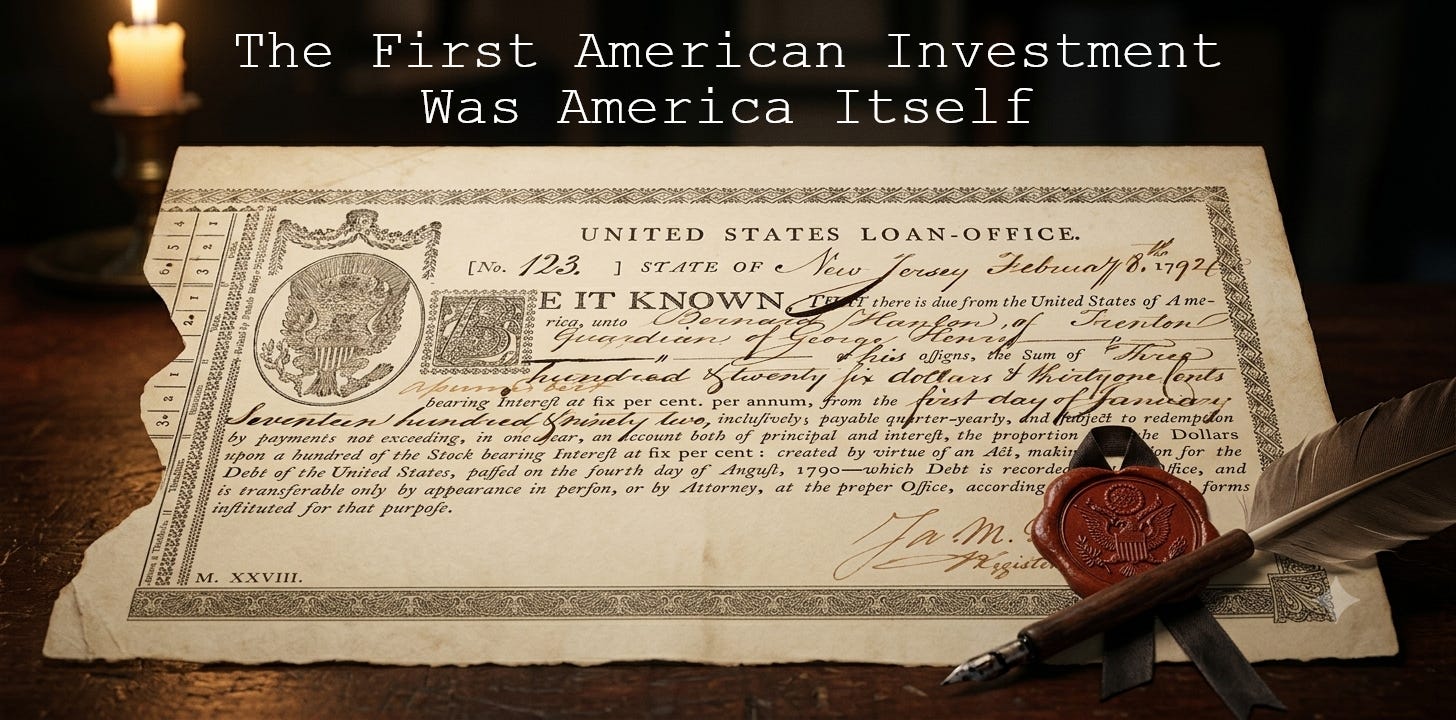
This year the United States turns 250. Its capital markets are a little younger, and their story is worth telling, because almost everything we deal with as investors today was already present at the start.
On July 4, 1776, the country was still an idea. A declaration is a statement of intent, not a balance sheet. The men who signed it pledged their lives, their fortunes, and their sacred honor, which is an eloquent way of saying they put capital at risk with no assurance of return. What they had was conviction. What they lacked was a market.
That came fourteen years later.
1790: The year the country got financed
By 1790 the war was won and the Constitution was ratified, but the young republic was buried in debt. The states owed money. The federal government owed money. Much of that debt changed hands for a fraction of its face value because few believed it would ever be repaid.
Alexander Hamilton, the first Treasury Secretary, made a decision that still shapes American finance. He proposed that the federal government assume the states’ debts and honor them in full. The logic was simple and radical. If the United States paid what it owed, its credit would be sound. If its credit was sound, it could borrow. If it could borrow, it could build.
For that to work, the debt had to trade. It needed a place where buyers and sellers could meet, agree on a price, and move paper. That place opened in Philadelphia, then the nation’s capital, in 1790. The Board of Brokers of Philadelphia was the first organized stock exchange in the United States, according to the Library of Congress. It first gathered at the Merchants Coffee House at Second and Walnut, a short walk from Independence Hall.
Consider what actually changed hands there. The earliest securities traded on the first American exchange were federal bonds. The founding trade of U.S. capital markets was a wager on whether the country would keep its word. Investing in America was not a slogan. It was the product.
1792: The first crash
Markets mature quickly under pressure, and this one matured in roughly eighteen months.
A speculator named William Duer, a former Treasury official, set out to corner the market in government debt and bank stock. He borrowed heavily, drew in partners, and issued notes backed by little more than his reputation. When the newly opened Bank of the United States tightened credit in early 1792, the scheme came apart. Duer defaulted in March. Prices collapsed. It was the first American financial panic.
It also produced the first American response to one. Hamilton did not let the market fend for itself. According to the Federal Reserve Bank of New York, he directed the Bank of the United States to buy government securities and had banks lend against sound collateral at a penalty rate. That is the lender-of-last-resort playbook, run nearly a century before Walter Bagehot set down the rules we still cite today.
Order followed the chaos. In May 1792, twenty-four brokers in New York signed the Buttonwood Agreement, adopting common rules and fixed commissions so that trades would reliably settle. That agreement is the origin of the New York Stock Exchange.
What the first two years already knew
Everything we manage today was present at the founding. Leverage. Speculation. The distance between price and value. The need for trust between counterparties. The role of a steady hand willing to stop a panic. All of it appeared inside the first twenty-four months of American markets, and none of it has left since.
The tools have changed beyond recognition. Paper certificates became electrons. A trade that once took days now clears in a fraction of a second. The structure has not changed at all. A market is still a place where people price the future and commit capital to a conviction. The question the Board of Brokers asked in 1790 is the same one we ask every day. Is this worth what they are asking, and will it pay.
Why the anniversary matters
There is a lesson in the fact that the country’s first investment was the country itself. Serious investing has always been an act of belief in an enterprise, tempered by hard scrutiny of whether that enterprise can deliver. The founders who bought federal debt in 1790 were not chasing a trend. They were underwriting a going concern and expecting to be paid.
Two hundred and fifty years later, that is still the work. The prices move faster and the instruments are more complex, but the discipline is unchanged. Understand what you own. Know what it is worth. Put capital behind conviction, and hold the line when the panic comes, because the panic always comes, and it always passes.
Sources
Library of Congress, “Wall Street and the Stock Exchanges: Stock Exchanges,” Research Guides. https://guides.loc.gov/wall-street-history/exchanges
Federal Reserve Bank of New York, “Crisis Chronicles: Central Bank Crisis Management during Wall Street’s First Crash (1792),” Liberty Street Economics. https://libertystreeteconomics.newyorkfed.org/2014/05/crisis-chronicles-central-bank-crisis-management-during-wall-streets-first-crash-1792/
“Panic of 1792,” Wikipedia. https://en.wikipedia.org/wiki/Panic_of_1792
“Philadelphia Stock Exchange,” Wikipedia. https://en.wikipedia.org/wiki/Philadelphia_Stock_Exchange
Richard Sylla, “The Panic of 1792 in the United States,” NBER. https://users.nber.org/~confer/2006/si2006/dae/sylla.pdf