


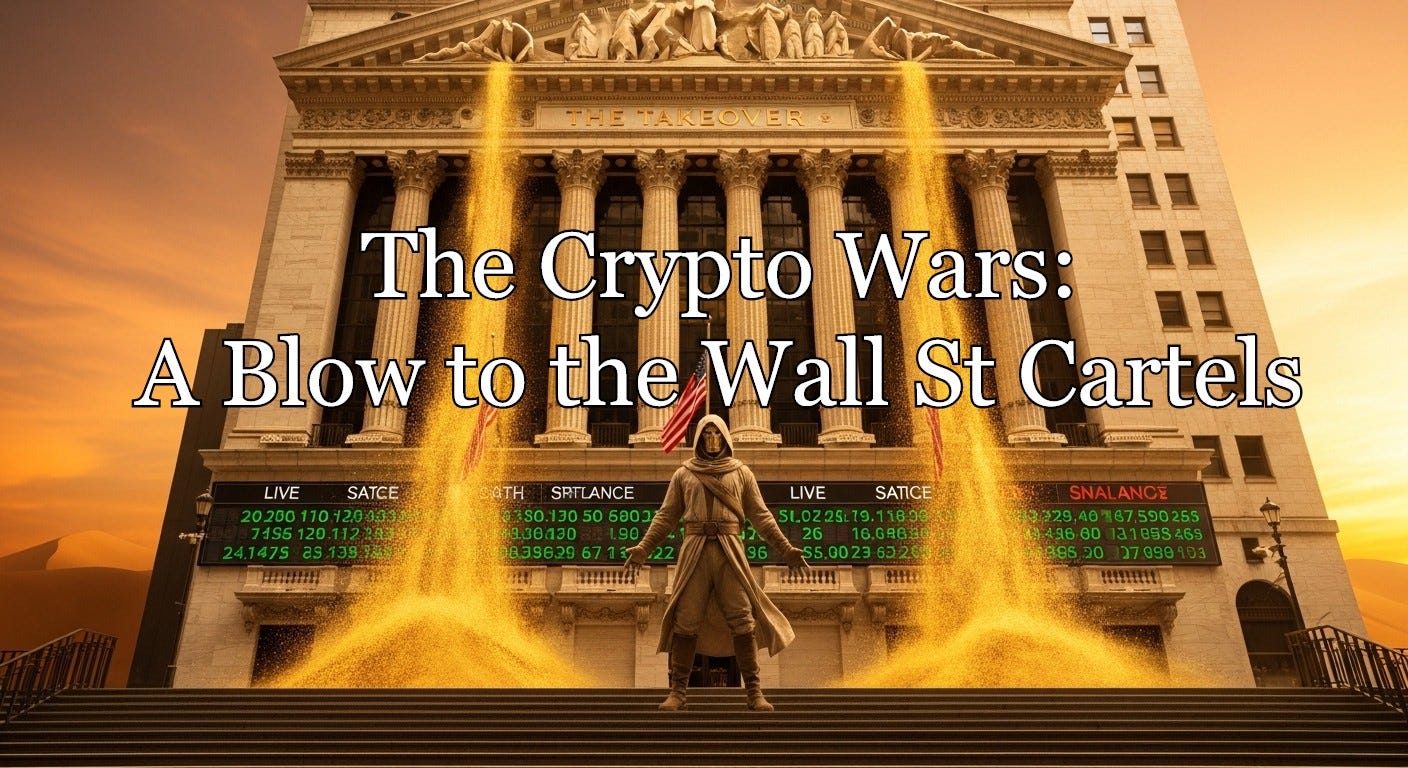
Frank Herbert, the author of Dune said: "He who controls the spice controls the universe." In capital markets, the spice is order flow — and for the first time in a century, Wall Street is losing its grip.
In 1965, Frank Herbert wrote the defining law of power: The spice also referred to as “melange” existed on one planet, flowed through one supply chain, and made interstellar travel possible. It was the single resource everything else depended on. Whoever sat between the source and the consumer owned the universe.
In capital markets, the spice is order flow. The trillions of dollars in buy and sell instructions that move every day from investors into markets. It is the one resource every exchange, broker, dark pool, and clearing house exists to capture. For a century, Wall Street’s wirehouses controlled it absolutely with retail brokerage, institutional sales, investment banking, proprietary trading, and the specialist on the trading floor. Like Arrakis, the fictional desert planet in Dune and the only place in the universe where the spice could be found, the entire operation was owned top to bottom by whoever held the most power.
The Fremen took the planet. In Herbert’s universe, the Fremen were the native people of Arrakis, the ones who had lived inside the desert their entire lives, adapted to conditions no outsider could survive, and needed nothing the Empire offered. They didn’t fight the Empire from the outside. They were already there, living within the very resource the Empire had built its power around. When the moment came, they didn’t storm the gates. They simply took what was always theirs. That moment is now March 2026.
The Precedent: Archipelago Didn’t Fight the NYSE — It Absorbed It
In 1997, a small electronic communications network launched out of Chicago called Archipelago began quietly routing stock orders faster and cheaper than the 200-year-old specialists on the NYSE floor. By 2005, it was processing billions in daily volume. By 2006, what the press described as a “merger” was actually something more remarkable: the New York Stock Exchange slipped into Archipelago’s for-profit corporate structure, becoming demutualized, publicly listed, and ultimately renamed NYSE Group. The incumbent didn’t acquire the disruptor. The disruptor reverse-merged the incumbent out of its own identity.¹
The ghost of Archipelago haunts every boardroom on Wall Street today. Because the same pattern of technology eating market structure from the outside is now running at ten times the speed, across every asset class simultaneously, with one crucial difference: this time, there is no corporate structure to reverse-merge. There are only protocols.
“NYSE didn’t buy Archipelago. Archipelago bought NYSE’s soul and kept the brand as a receipt.”
The SEC Interpretation: Landmark Ruling, Not Yet Law
On March 17, 2026, the SEC and CFTC jointly released what may be the most consequential financial document of the decade: a formal interpretation classifying crypto assets into five categories including digital commodities, digital collectibles, digital tools, stablecoins, and digital securities. Bitcoin, Ethereum, Solana, and XRP were named explicitly as digital commodities, not securities.²
Important distinction
This is an interpretation, not legislation. Not Statutory Law The SEC and CFTC have stated they will administer existing laws consistently with this framework. It supersedes all prior staff statements. The Clarity Act, which would codify these definitions into statute, has passed the House but remains pending in the Senate. Clarity Act: Pending Senate The Nasdaq tokenization rule, however, received full SEC approval on March 18, 2026, making it a binding rule change. SEC Rule: Approved
The practical effect is immediate regardless of its statutory status: the SEC dropped the “regulation by enforcement” posture of the previous administration. Companies that were operating in legal ambiguity now have a clear taxonomy. And critically, protocol mining, staking, wrapping, and qualifying airdrops are all explicitly outside securities law. The compliance moat Wall Street counted on, using regulatory complexity as a barrier to entry, has been partially drained.
The Exchange Wars: NYSE and Nasdaq Choose Their Partners
The week of March 9–18, 2026 will be studied in finance schools. In rapid succession: Nasdaq partnered with Kraken to build the “Equity Transformation Gateway,” enabling 24/7 tokenized trading of listed stocks globally. ICE, NYSE’s parent company, made a strategic investment in OKX at a $25 billion valuation, with plans to offer tokenized NYSE stocks to OKX’s 120 million users by late 2026. And the SEC approved Nasdaq’s rule change allowing securities to settle as blockchain tokens alongside traditional shares with the same ticker, same CUSIP, same rights, and opt-in blockchain settlement.³
Notably absent from either partnership: Coinbase. The irony is sharp. ICE, NYSE’s parent, was an early Coinbase investor but then sold its entire 1.4% stake for $1.2 billion at Coinbase’s 2021 IPO. Now Coinbase is building its own “Everything Exchange” designed to compete directly with NYSE and Nasdaq. The exchanges partnered with the challengers; the biggest US crypto exchange decided to become the challenger itself.⁴
The DeFi Flank: Hyperliquid and the Protocol That Can’t Be Acquired
While the exchanges negotiate partnerships, a physics Olympiad gold medalist and former Hudson River Trading engineer named Jeff Yan has quietly built something the traditional playbook cannot touch. Hyperliquid, a purpose-built Layer 1 blockchain running a custom consensus mechanism called HyperBFT, processed $2.95 trillion in derivatives volume in 2025 with a team of eleven people and zero venture capital.⁵
Unlike Archipelago, there is no board to negotiate with, no headquarters to visit, no equity to purchase. The protocol runs on 21 validators. Its governance token is held by hundreds of thousands of anonymous wallets globally. When Nasdaq bought INET and NYSE absorbed Archipelago, they ran a playbook that has worked every time for 30 years: acquire the disruptor, absorb the technology, retain the brand. That playbook requires a counterparty. Hyperliquid offers none.
Then on March 18, 2026, the same day the SEC approved Nasdaq’s tokenization rule, S&P Dow Jones Indices officially licensed the S&P 500 to trade as a perpetual derivatives contract on Hyperliquid via Trade[XYZ].⁶ Not a synthetic approximation. Not an unlicensed price feed. The actual S&P 500 trademark, licensed by the world’s preeminent index provider that administers benchmarks tracking over $16 trillion in indexed assets, to a DeFi protocol trading 24/7 with no exchange, no clearing house, and no market hours. The cartel’s most prized benchmark. On their rails. HYPE jumped 10% on the news even as the broader crypto market sat in extreme fear, Fear & Greed Index at 23.
As the tokenized securities market grows, the most dangerous scenario for traditional exchanges is not that Hyperliquid competes with them. It’s that volume migrates to protocols they cannot regulate, acquire, or replicate fast enough.
Investor Implications: What This Means for Your Portfolio
If you hold a spot Bitcoin ETF such as BITB: Bitcoin’s explicit classification as a digital commodity, not a security, removes one of the largest regulatory overhangs over the asset. The SEC’s interpretation effectively validates Bitcoin as a legitimate asset class under US law. This is structurally bullish for the underlying holdings of any spot Bitcoin product. Investors should compare expense ratios across available products, as fees vary meaningfully between issuers and compound over time.
Direct exposure to the infrastructure layer: The deeper opportunity may lie not in the assets themselves but in the companies and protocols building the new financial rails. Publicly traded crypto-native platforms, exchange operators expanding into digital assets, and fintech firms with tokenization capabilities all offer indirect exposure to the structural shift with varying risk profiles and regulatory considerations. As always, the infrastructure layer tends to monetize more durably than the assets that run on it.
The DeFi native exposure: Governance tokens for leading on-chain trading protocols offer direct participation in trading infrastructure volume, essentially owning a piece of the exchange in a world where exchanges are protocols. These are high-risk, high-volatility instruments appropriate only for risk capital explicitly designated for speculative positions. Due diligence on tokenomics, team, and protocol security is essential before any allocation.
Watch the Clarity Act: If the Senate passes legislation codifying the SEC interpretation into statute, it removes the last significant regulatory risk for institutional allocation. That is the potential catalyst for the next major leg of institutional capital inflow across the entire asset class.
The Psychology Every Investor Should Understand
Anchoring to the wrong precedent. Most investors anchor to the 2017 and 2021 crypto cycles, speculative frenzies followed by 80%+ drawdowns. The current structural shift is categorically different: regulated exchanges going on-chain, the world’s largest asset manager invested in Uniswap, the SEC providing a taxonomy. The precedent is not 2017. It’s 1999, when Reg ATS formalized ECN trading and the institutional buildout began.
FOMO vs. structural positioning. The psychological trap is binary thinking: either “crypto is going to zero” or “buy everything now.” The more productive frame is infrastructure investing: who owns the rails when every asset class settles on-chain? Those companies exist today and are publicly traded.
Recency bias and volatility. Bitcoin’s correlation to risk assets during macro stress (rate decisions, tariff shocks) is real and will remain. Holding a spot Bitcoin ETF means accepting that the asset will sell off when the market sells off, regardless of the long-term structural thesis. Position sizing matters more than conviction in this environment.
The Archipelago lesson for investors: The people who made the most money from the ECN revolution weren’t the ones who predicted it earliest. They were the ones who sized correctly and held through the regulatory noise. The structural shift takes longer than enthusiasts predict and faster than skeptics believe. Both groups tend to lose money. Patient conviction, sized appropriately, is the edge.
Ready to Position Your Portfolio for the Structural Shift?
The architecture of capital markets is changing faster than most investors realize. If you want a second opinion on your current holdings or want to build a portfolio structured around where the rails are going, not where they’ve been, let’s talk.
The Cartel’s Walls Are Cracking
Wall Street’s control over capital markets has always rested on four pillars: ownership of the matching infrastructure, control of the clearing and settlement layer, regulatory complexity as a moat, and distribution. That last pillar is the one most analysts forget. It’s also the most important.
Consider why Archipelago really won. It wasn’t just the matching engine. Archipelago controlled RealTick, the dominant trading platform for active retail and professional traders and the software that funneled order flow directly into ArcaEx. It owned Terra Nova Trading, the retail-facing broker that captured individual investor flow. And it owned Wave Securities, the institutional side of the house. The wirehouses, Goldman, Merrill, and Morgan Stanley, had dominated because they owned the full stack: retail brokerage, institutional sales, investment banking, proprietary trading, and the specialist market-making function on the floor. Archipelago built a parallel distribution stack and routed it all through a superior electronic engine. They didn’t just build a better exchange. They owned the flow that made the exchange matter. In markets, whoever controls distribution controls the Spice, and whoever controls the Spice controls everything.
The events of March 2026 have now weakened all four pillars simultaneously. The SEC’s interpretation removed the regulatory ambiguity that kept institutional capital on the sidelines. Nasdaq and NYSE partnered with Kraken and OKX, acknowledging they need crypto’s users more than crypto needs their order books. The DTCC tokenization pilot begins dismantling the clearing monopoly. And Hyperliquid, with eleven engineers and zero venture funding, processed nearly $3 trillion in derivatives volume on infrastructure no regulator can shut down and no exchange can acquire, then landed the world’s most iconic benchmark as a client. There is no CEO to subpoena. There is no equity to purchase. There is no table.
But the most strategically dangerous player in this transformation is not Hyperliquid. It’s Robinhood. Twenty-three million accounts. MiCA approval across 30 EU and EEA countries. Stocks, crypto, options, futures, tokenized securities, retirement accounts, a credit card, a $1 billion private equity fund, and its own Layer 2 blockchain, all in one app. NYSE and Nasdaq partnered with OKX and Kraken because they needed their user bases. Robinhood doesn’t need anyone’s user base. It already owns retail distribution, and it is quietly routing that flow toward a blockchain-native settlement layer it controls. Like Archipelago before it, Robinhood doesn’t just want to build a better exchange. It wants to own the flow that makes the exchange matter. It already has distribution. It already has the Spice.
Herbert’s Emperor didn’t lose Arrakis because his army was weak. He lost it because the Fremen were already living inside the flow, needing nothing the Guild offered. Robinhood didn’t seize order flow by fighting Wall Street. It captured 23 million people’s trades before Wall Street realized the desert had changed hands. NYSE and Nasdaq are now negotiating with the Fremen. That is not a partnership. That is a concession.
Archipelago’s founders sat across the table from NYSE’s CEO and signed the deal that remade American finance. The next generation of disruptors won’t be sitting across any table. There is no table. There is only code, consensus, and order flow migrating to where friction is lowest.
He who controls the spice controls the universe. The spice has a new home.
Sources & References
NYSE-Archipelago Merger (2006). Archipelago Holdings reverse merger with NYSE Group. Illinois Venture Capital Association; Chicago Tribune, March 8, 2006.
SEC & CFTC. “Application of the Federal Securities Laws to Certain Types of Crypto Assets.” Release Nos. 33-11412; 34-105020. March 17, 2026.
CoinDesk. “SEC Approves Nasdaq’s Move to Allow Tokenized Securities Trading.” March 18, 2026. Nasdaq/Kraken partnership announced March 9, 2026; ICE/OKX investment announced March 5, 2026.
CoinDesk. “NYSE-Owner ICE Sold Coinbase Stake for $1.2B.” April 30, 2021. Fortune. “Robinhood Ventures / Coinbase Everything Exchange Strategy.” March 2026.
Fortune. “How a Harvard Grad Helped Make Hyperliquid the Biggest New Player in Crypto — With Just 11 People and No Venture Funding.” January 12, 2026. Hyperliquid Labs Documentation: hyperliquid.gitbook.io
Grayscale Investments. GBTC Spot ETF Conversion, January 2024. BlackRock IBIT expense ratio comparison data.
Copyright © 2026 All rights reserved. This blog is copyright protected. No part may be reproduced, altered, or copied in any form without written consent. Information contained herein is for informational purposes only and should not be construed as an offer, solicitation, or recommendation to buy or sell securities, or personalized investment, tax or legal advice. The information has been obtained from sources believed to be reliable; however no guarantee is made or implied with respect to its accuracy, timeliness, or completeness. Authors may own the stocks they discuss. The information and content are subject to change without notice. Treveri Capital LLC is a California registered investment advisor. CRPC®, Chartered Retirement Planning CounselorSM are trademarks or registered service marks of the College for Financial Planning in the United States and/or other countries.